
Tax Relief & e-Filing Cukai Malaysia YA 2025
Tax Relief & e-Filing Cukai Malaysia YA 2025
e-Filing of Income Tax in Malaysia usually begins in March, and for the Year of Assessment (YA) 2026, this will be no different. Taxpayers will once again be required to declare their income through LHDN’s MyTax portal. If this is your first time filing your income tax, this can be daunting.
Whether this is your first time filing your income tax return or simply need a refresher, understanding tax relief, tax exemptions and the e-filing process can help you stay compliant and avoid any unnecessary issues down the road, and this article serves as a guide in this regard.
Who Needs to File Income Tax?
In Malaysia, a person who earns a RM2,833.33 or more (RM34,000 annually) in salary under employment after deduction of Employees Provident Fund (EPF) or from an income from working independently or as a freelancer will be required to file and pay income tax. This threshold calculation for an individual NOT TAXABLE takes into account the annual gross income minus individual’s basic relief and eligible tax rebates. More specifically, the below table shows the individual income threshold for individuals who are NOT TAXABLE according to the different types of assessment.
|
TYPE OF ASSESSMENT |
ANNUAL INCOME (RM) |
MONTHLY INCOME (RM) |
|
Single / widow / widower / divorcee / spouse with no income |
37,333 |
3,111.08 |
|
SEPARATE |
||
|
Married + 0 Children |
37,333 |
3,111.08 |
|
Married + 1 Children |
||
|
Married + 2 Children |
41,333 |
3,444.42 |
|
JOINT |
||
|
Married + 0 Children |
48,000 |
4,000.00 |
|
Married + 1 Children |
50,000 |
4,166.67 |
|
Married + 2 Children |
52,000 |
4,333.33 |
Many Malaysians assume that if they earn a low salary, they do not need to bother about paying or filing a tax returns. In reality, however, most individuals who receive an income are encouraged to submit a tax return even if their income falls below the threshold and they are not liable to pay income tax. This is important for record-keeping, future loan or financing applications, eligibility for government subsidies or to avoid penalties or complications in the future.
Tax Relief Updates for 2025
For individuals needing to file and pay their income tax, they may be interested to know about tax reliefs that are available to them for the year 2025 (YA 2026) to help them maximize their tax relief claims. These includes:
First-Time Home Loan Interest
This relief is applicable to first-time residential home ownership (individual or joint ownership) with individuals who fulfil the following criteria:
● Sales and Purchase Agreement (SPA) signed between 1 January 2025 to 31 December 2027
● Annual relief: RM7,000 for homes valued up to RM500,000; RM5,000 for home valued RM500,001 – RM750,000
● Eligible for 3 consecutive assessment years starting from the year interest is paid
This relief aims to ease the financial burden for Malaysians purchasing their first residential property.
Education and Medical Insurance Premiums
The tax relief cap for education and medical insurance premiums has been increased from RM3,000 to RM4,000 per individual. This allows taxpayers to claim a higher amount for insurance policies covering education, medical or health-related expenses.
Persons with Disabilities (PWD) and Dependents
Additional relief is available for individuals with disabilities and taxpayers supporting dependents with disabilities. These reliefs are designed to provide financial support and recognize higher living and care costs.
The below table shows the comparison of the relief before 2025, and the updated limits 2025 limits:
|
Category |
Relief Before 2025 (YA ≤ 2024) |
New Relief 2025 (YA 2025 onwards) |
|
Individual PWD (taxpayer) |
RM6,000 |
RM7,000 |
|
PWD Spouse |
RM5,000 |
RM6,000 |
|
Unmarried PWD Child |
RM6,000 |
RM8,000 |
Tax Relief Entitlements
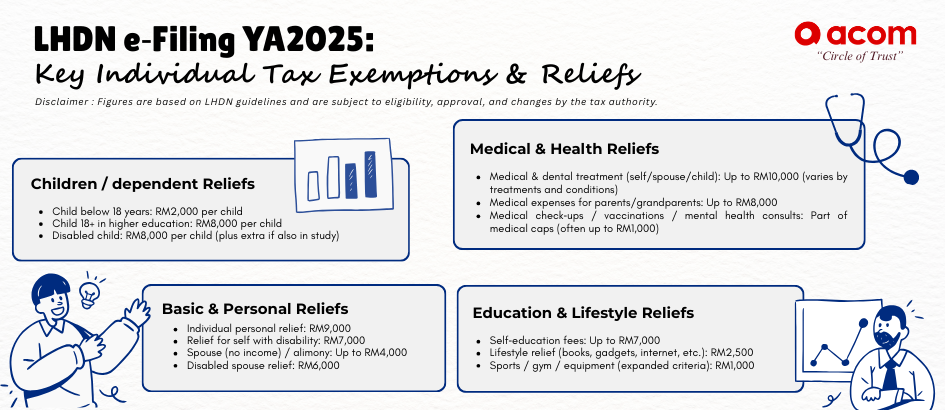
1. Individual Tax Relief
● Individual and dependent relatives: RM9,000
● Disabled individual: RM7,000
● Disabled spouse: RM6,000
● Spouse / alimony to former wife: RM4,000
● Self-education fees: RM7,000
● First-Home Loan Interest with a Sale and Purchase Agreement dated between 1 January 2025 – 31 December 2027:
o RM7,000 for homes valued up to RM500,000
o RM5,000 for homes valued between RM500,001 – RM750,000
o Valid for 3 consecutive assessment years starting from the year the interest is paid
2. Medical, Lifestyle & Related Equipment Tax Relief
● Medical expenses (self/spouse/child) with a total of RM10,000 for:
o Serious disease
o Fertility treatment (self/spouse)
o Approved vaccination (limited to RM1,000)
o Limited to RM1,000 for these items: full medical check-up, COVID-19 detection tests, mental health check-ups or consultations
o Diagnosis / rehabilitation for Learning Disability Child (limited to RM4,000)
● Medical treatment for special needs and parental care: RM8,000
● Special support equipment (self/spouse/child/parent): RM6,000
● Installation/rental/purchase/facilities for electric vehicle charging for personal use: RM2,500
● Lifestyle: RM2,500
● Additional lifestyle relief related to sports activities (self/spouse/child): RM1,000
3. Child Tax Relief
● Child under 18 years old: RM2,000
● Child 18 years and above:
o Unmarried/full-time student: RM2,000
o Unmarried/Studying at higher education institution: RM8,000
● Registered childcare centre / kindergarten fees for child 6 years old & below: RM3,000 (deduction only for either husband or wife)
● Disabled child: RM8,000
o Additional relief for disabled child RM8,000 (18 years old or above, studying at higher education institution – Diploma or above)
● Purchase of breastfeeding equipment: RM1,000
4. Contributions / Donations Tax Relief
● Life insurance and EPF: RM7,000
o Life insurance premium/EPF (voluntary)/both: limited to RM3,000
o EPF (voluntary/compulsory/approved scheme): limited to RM4,000
● PERKESO: RM350
● Retirement scheme and deferred annuity: RM3,000
● Medical and education insurance (self/spouse/child): RM4,000
● SSPN (Nett Savings): RM8,000
For further details on the tax reliefs available, you can visit https://www.hasil.gov.my/en/individual/individual-life-cycle/income-declaration/tax-reliefs/
How to Do E-Filing
1. Apply to get an income tax number
If this is your first time paying taxes, before you use e-Filing, you need to register to get an income tax number. There are 2 ways to get an income tax number:
● Online e-Daftar Online (e-Daftar) | Lembaga Hasil Dalam Negeri Malaysia or
● Manually by filing out a form at an LHDN branch counter
2. Register to get the MyTax LHDN PIN number and generate a MyTax Digital Certificate
Once you have your income tax number, you will need to request a PIN number to activate your account on the MyTax LHDN Portal. The PIN number and step-by-step registration process can be accessed by obtaining the user manual from MyTax


3. Fill out the LHDN e-Filing for the Year of Assessment 2026

Once the profile on MyTax Portal has been created, you may enter the portal to fill up the LHDN e-Filing form to submit your tax returns. To do this:
1. Go to MyTax Portal for e-Filing 2026 login and click on “Click here for Filing & Submission” on the right menu
2. Select the year of assessment for your status to fill out the form.
The available forms available on the MyTax Portal is as below:
Resident Individuals
● e-BE: No Business Income
● e-B: With Business Income
● e-BT: Knowledge Worker or Non-Resident holding key positions or skilled workers approved by the Minister
Non-Resident Individuals
● e-M: Non-Resident Individuals
● e-MT: Knowledge Worker subject to approval by minister
Non-Individuals
● e-P: Partnership Tax Return Form
● e-E: Employer’s Tax Return Form
Key Dates to Note
The start date to fill out the e-Filing form for YA 2026 starts on 1 March 2026. Other key dates to remember are as follow:
For Individuals without business income
● Manual submission: by 30 April 2026
● E-Filing submission: by 15 May 2026
For Individuals with business income
● Manual submission: by 30 June 2026
● E-Filing submission: by 15 July 2026
Understanding the Tax Relief and e-Filing Process
Understanding tax relief and the e-filing process is an important step towards better financial management. Even if you do not pay income tax, filing your return helps maintain proper records and access future benefits. To get started, register an account on the MyTax portal and ensure your income tax filing is up to date.
Managing income tax payments can sometimes create short-term financial pressure, especially when facing lump-sum tax obligations or unexpected additional assessments. In such situations, exploring responsible financing solutions from licensed providers such as ACOM (M) may help individuals better manage their cash flow while fulfilling tax commitments on time. Taxpayers are encouraged to review loan terms carefully, borrow responsibly, and only engage through official and verified channels when considering personal loan options.
Disclaimer : Figures are based on LHDN guidelines and are subject to eligibility, approval, and changes by the tax authority.
